
A lot of my clients who experience depression or anxiety enter therapy not knowing why they feel low or anxious. At times they might say ‘..it just suddenly kicked in’, ‘it was following a difficult life situation’ ‘It was scary to suddenly go into a really dark place’. It can take months or years before most people actually seek help or access therapy following such events.
But what is depression or anxiety in the first place? Why do we feel that way? Is it due to a chemical imbalance? Or a stressful life situation? The nature nurture debate still continues. But I am a strong believer of life experiences impacting our mood. In my professional experience, I have seen that there is usually an event or a series of events which triggers feeling low or anxious. I often use something called a ‘timeline’ which is basically a history of significant events in individuals’ lives. When we reflect on this timeline of events and explore it in depth, it is clear to both my clients and myself of what led to a decline in mental health.
Anxiety and depression are not problems in themselves but ways of coping and responding to life events. They are a normal response to overwhelming and challenging life situations – coping strategies that helped us in the past but no longer do.
Now, I am not saying that a break up or loss of a loved one can always lead to feeling this way. We all react to events in various ways – our coping styles, environment, social support, resources, and practical issues such as finance and housing have a massive role to play. So do our past life experiences. There is no formula for this but the way we cope with and respond to events can impact how they impact us in the long run.
Let me explain. Let’s say 10 year old Megan lost both her parents at the age of 10. They died due to a drug overdose. Her grandparents took her into their custody. Everyone around her including friends and family did not tell her what really happened at the time – how her parents died, what death means, or any discussion on the topic. A 10 year old may not understand some of these things and her family was doing their best to protect her. There was almost a pretence that ‘everything is ok’ and her grandad took her to a funfair the day her dad died to get Megan’s mind off it. That probably did work for a period of time. But what it taught Megan is that this was either a big secret and shouldn’t be talked about, or you deal with problems by shoving them under the carpet. So, that’s what she did. She started denying, ignoring or invalidating her feelings of grief by distracting herself with work. She was always busy. Busy doing anything. Her anxiety kept her going, worrying, stressing and being busy in her head. So, she had no time to think about her parents’ death. A great way to cope, you’d think. But that can only last for a while, until it can’t be suppressed anymore. A bit like a balloon with air – keep filling the air in and it is bound to burst one day. The dam will overflow at some point. What more, now that she has crippling anxiety, she feels judged for being ‘weak’ and tries suppressing her feelings further.
She was always busy. Busy doing anything. Her anxiety kept her going, worrying, stressing and being busy in her head. So she had no time to think about her parents’ death.
My point is: suppressing feelings and experiences can re-emerge as anxiety and depression. Anxiety and depression are not problems in themselves but ways of coping and responding to life events. They are a normal response to overwhelming and challenging life situations – coping strategies that helped us in the past but no longer do. And we did our best to cope with what we knew. There is no shame here, just a way of surviving and making it through.
What about depression though? Harry grew up in a family where men were meant to be strong and tough. When he was bullied in school, he would respond with aggression – this was a sort of protection from being hurt. He displayed anger but covered the sadness and pain underneath. You’ve probably heard of the flight, fight, freeze or fawn response but wondered why some people choose one over another? Depends on the context but also factors such as our relationship to emotions, what works for us and what we learnt in our families – do we fight back or stay silent? Back to Harry. It was years of masking the pain and low self-confidence before he came to therapy feeling depressed, isolated and housebound. He was ashamed of himself and carried a lot of guilt for displaying aggression. It was a vicious loop he was stuck in.
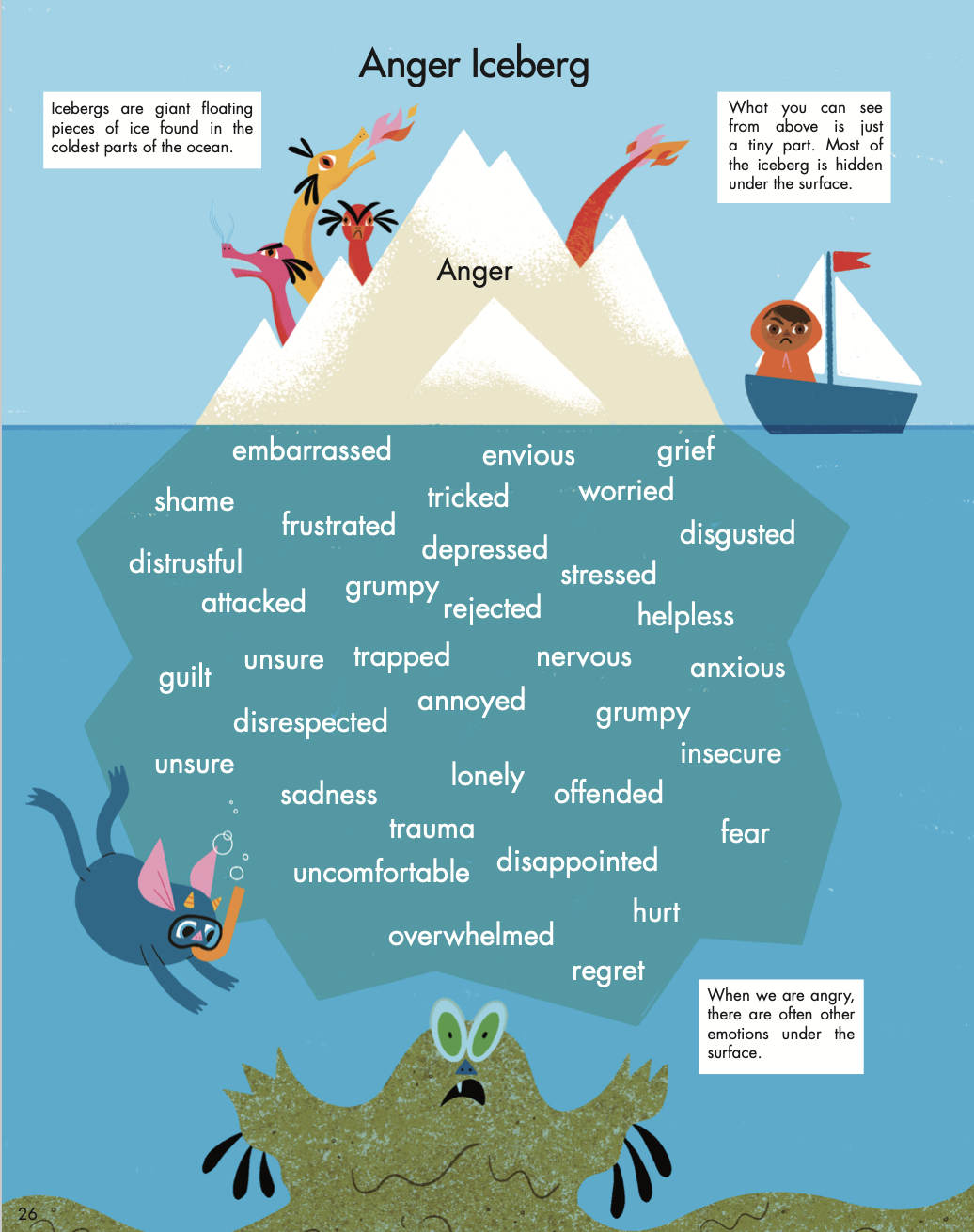
I tend to use the anger iceberg a lot when working with my clients (picture below). As we know, you can only see the tip of an iceberg from the surface but most of it lies beneath. Similarly, we might display more ‘acceptable’ emotions and suppress ones that are more difficult to express or feel. Acceptable to whom, you may ask. Acceptable to oneself and others, people around us, family and society in general. Although it is called an ‘anger iceberg’ it could be any emotion at the top of the surface depending on what is acceptable to you – joy, sadness, guilt… take your pick!
Evidence from research points in a similar direction regarding suppressing emotions. In fact, bottling up feelings can have not only psychological but physiological impacts as well. For example, it has been linked to aggression, heart disease, cancer and mortality (Chapman et al., 2013; Quartana & Burns, 2010; Grossarth-Maticek, Bastiaans & Kanazir, 1985).
The natural question arises, so what can I do? Click here for the Part 2 of this article (coming soon).

Author: Dr. Soha Daru, HCPC Registered Counselling Psychologist
Contact: innerbeamcounselling@gmail.com
References
Anger Iceberg (2021). Creative Play therapist. Retrieved from https://creativeplaytherapist.com/anger-iceberg/
Chapman, B. P., Fiscella, K., Kawachi, I., Duberstein, P., & Muennig, P. (2013). Emotion suppression and mortality risk over a 12-year follow-up. Journal of psychosomatic research, 75(4), 381-385. doi: 10.1016/j.jpsychores.2013.07.014
Grossarth-Maticek, R., Bastiaans, J., & Kanazir, D. T. (1985). Psychosocial factors as strong predictors of mortality from cancer, ischaemic heart disease and stroke: the Yugoslav prospective study. Journal of psychosomatic research, 29(2), 167-176. 10.1016/0022-3999(85)90038-8
Quartana, P. J., & Burns, J. W. (2010). Emotion suppression affects cardiovascular responses to initial and subsequent laboratory stressors. British Journal of Health Psychology, 15(3), 511-528. doi: 10.1348/135910709X474613
 Dr. Soha Daru
One thought on “Why am I anxious and depressed? A trauma perspective”
Comments are closed.